
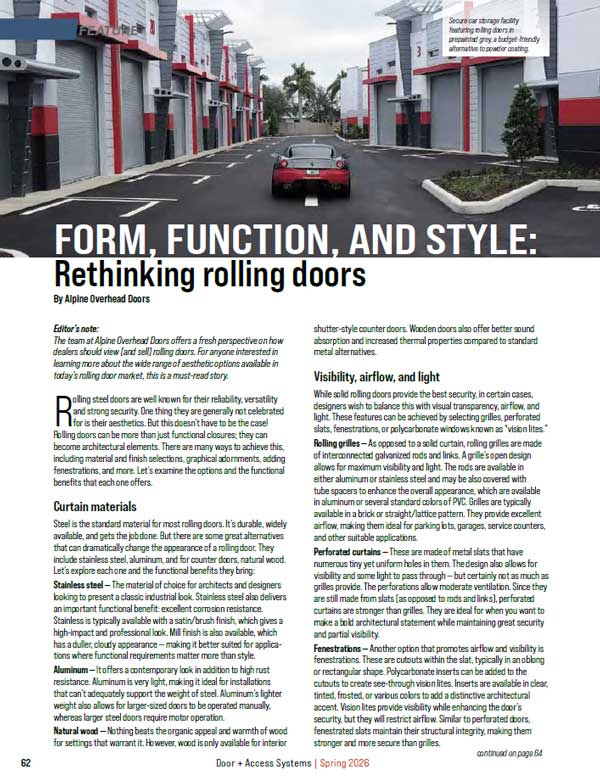
 This article by Alpine Overhead Doors originally appeared in the December 2026 Edition of DASMA’s magazine, Door + Access Systems. Republished with permission.
> Click here to view/download as a PDF.
Editor’s note:
The team at Alpine Overhead Doors offers a fresh perspective on how dealers should view (and sell) rolling doors. For anyone interested in learning more about the wide range of aesthetic options available in today’s rolling door market, this is a must-read story.
Rolling steel doors are well known for their reliability, versatility and strong security. One thing they are generally not celebrated for is their aesthetics. But this doesn’t have to be the case! Rolling doors can be more than just functional closures; they can become architectural elements. There are many ways to achieve this, including material and finish selections, graphical adornments, adding fenestrations, and more. Let’s examine the options and the functional benefits that each one offers.
Curtain materials
Steel is the standard material for most rolling doors. It’s durable, widely available, and gets the job done. But there are some great alternatives that can dramatically change the appearance of a rolling door. They include stainless steel, aluminum, and for counter doors, natural wood. Let’s explore each one and the functional benefits they bring:
Stainless steel — The material of choice for architects and designers looking to present a classic industrial look. Stainless steel also delivers an important functional benefit: excellent corrosion resistance.
Stainless is typically available with a satin/brush finish, which gives a high-impact and professional look. Mill finish is also available, which has a duller, cloudy appearance — making it better suited for applications where functional requirements matter more than style.
Aluminum — It offers a contemporary look in addition to high rust resistance. Aluminum is very light, making it ideal for installations that can’t adequately support the weight of steel. Aluminum’s lighter weight also allows for larger-sized doors to be operated manually, whereas larger steel doors require motor operation.
Natural wood — Nothing beats the organic appeal and warmth of wood for settings that warrant it. However, wood is only available for interior shutter-style counter doors. Wooden doors also offer better sound absorption and increased thermal properties compared to standard metal alternatives.
Visibility, airflow, and light
While solid rolling doors provide the best security, in certain cases, designers wish to balance this with visual transparency, airflow, and light. These features can be achieved by selecting grilles, perforated slats, fenestrations, or polycarbonate windows known as “vision lites.”
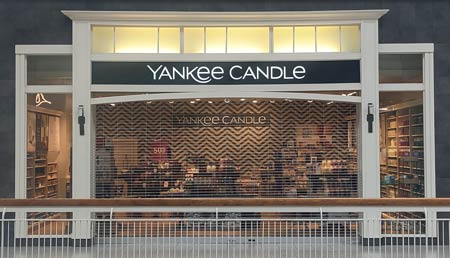
Rolling grilles — As opposed to a solid curtain, rolling grilles are made of interconnected galvanized rods and links. A grille’s open design allows for maximum visibility and light. The rods are available in either aluminum or stainless steel and may be also covered with tube spacers to enhance the overall appearance, which are available in aluminum or several standard colors of PVC. Grilles are typically available in a brick or straight/lattice pattern. They provide excellent airflow, making them ideal for parking lots, garages, service counters, and other suitable applications.
Perforated curtains — These are made of metal slats that have numerous tiny yet uniform holes in them. The design also allows for visibility and some light to pass through — but certainly not as much as grilles provide. The perforations allow moderate ventilation. Since they are still made from slats (as opposed to rods and links), perforated curtains are stronger than grilles. They are ideal for when you want to make a bold architectural statement while maintaining great security and partial visibility.
Fenestrations — Another option that promotes airflow and visibility is fenestrations. These are cutouts within the slat, typically in an oblong or rectangular shape. Polycarbonate inserts can be added to the cutouts to create see-through vision lites. Inserts are available in clear, tinted, frosted, or various colors to add a distinctive architectural accent. Vision lites provide visibility while enhancing the door’s security, but they will restrict airflow. Similar to perforated doors, fenestrated slats maintain their structural integrity, making them stronger and more secure than grilles.
Color and durability
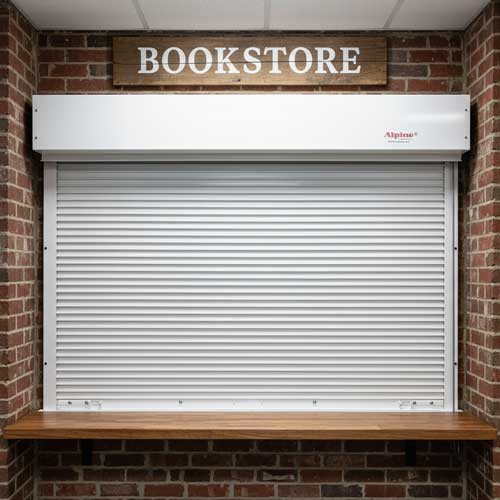
Prepainted steel — Most manufacturers will offer certain doors in standard colors such as white, tan, and grey. Rather than coating these at the factory, the steel used to make them arrives prepainted from the supplier. The paint is applied at a thickness of 1.5 mils, providing a layer of surface protection. Benefits include lower cost (due to the higher volumes and availability of the material) and consistency. While prepainting offers surface protection, powder coating, which we will cover next, is more durable.
Powder coating — Many rolling door curtains and visible components can be powder-coated in standard or custom colors to match an organization’s brand colors or architectural pallet. With this process, ground pigment and resin particles are baked onto the components, creating a hard and durable coating that is 2.5 to 3.5 mils thick. In addition to adding color, this protective layer provides resistance to scratches, chemicals, and UV rays.
Branded hoods
Hoods serve a critical role by protecting the barrel assembly and the curtain when a door is open. Rather than concealing the hood, it can be intentionally highlighted as part of a building’s architectural aesthetic. Hoods can be custom-wrapped or powder-coated, and company logos and graphical branding elements can be added to the hood’s surface. These enhancements will turn an often-overlooked functional component into valuable visual real estate.
An opportunity for dealers and installers
Sharing the aesthetic potential of coiling doors presents revenue opportunities for dealers and installers. By incorporating these options into your proposals, your average project value will increase. Furthermore, when having helpful design conversations with buyers, you’ll set yourself apart from your competitors. You’ll be respected as a helpful and trusted partner, which often leads to repeat business and referrals.
Don’t sacrifice style for security!
As you can see, coiling doors can evolve past their traditional role as security doors to serve as true architectural and unique design elements. Many of these considerations also bring functional benefits, such as improved corrosion resistance, ventilation, and more.
When specifying rolling doors, the key is to strike a balance between functional, aesthetic, and budgetary requirements. By selecting the right style, material, and other features, you can have rolling doors that are both architecturally appealing and deliver the security and reliability you need.
Philip Paranicas and the team at Alpine Overhead Doors wrote this article. Since 1972, Alpine has been manufacturing rolling overhead door systems, including service and insulated doors, fire- and storm-rated doors, and storefront doors, shutters, grilles, and high-performance coiling doors.