
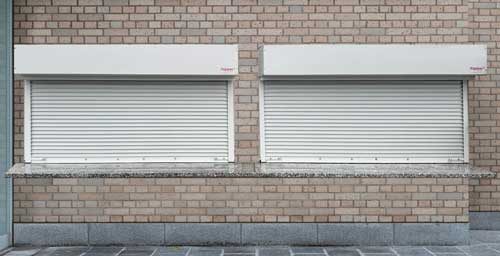
Selecting the right counter shutter for a particular application is critical for security and performance. There are as many options as there are applications for counter doors. These include materials, finishes, slat profile and design, operation methods, security features and other considerations such as fire and smoke protection. In this guide, we will review each of these characteristics to help you select the right configuration for your needs.
What Are the Primary Counter Shutter Requirements?
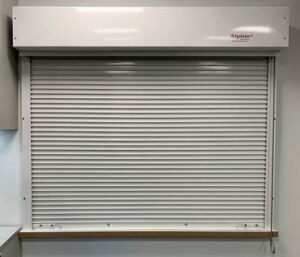 Before we get into the specifications and options, you’ll need to start by identifying the core requirements. For instance, is off-hours security a primary concern? How often will the shutter be cycled? Just twice a day, or constantly throughout the day?
For a high-traffic use, such as a busy cafeteria or airport kiosk, durability and easy of operation will be the primary factors. You’ll need a door that can handle many cycles per day, but hold up overtime. Conversely, if the counter door is in a retail environment such as a pharmacy or ticket counter, you can prioritize aesthetics over operation. However, options such as fire and smoke rating requirements are determined by local building/fire codes. We’ll get back to that in a bit.
Counter Door Curtain/Slat Profile and Design
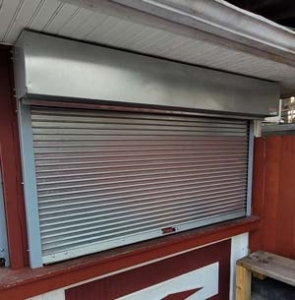 Counter doors come in a variety of curtain configurations. They are loosely grouped as two main types: slats or grilles. Let’s look at the options:
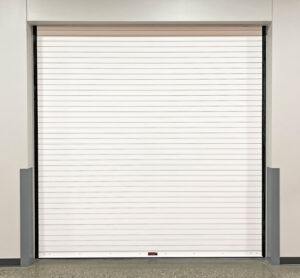
Slats – these are typically offered in two profiles: flat or curved. Flat slats create a cleaner, more modern appearance. They stack compactly and require less headroom. Curved slats, on the other hand, provide enhanced security and improve insulated, but are bulkier and take up more headroom. Slats can also be perforated, which brings the benefits of airflow and visibility. Some manufacturers may offer fenestration as well, these are cut outs that offer visibility and airflow as well but can be less secure depending on the exact configuration.
Counter Grilles – these offer a lattice or mesh design, sometimes referred to as “brick”. They offer maximum visibility and airflow, while still providing security. The curtains are made from interlocking metal bars, rods or wire. These are best for applications where product visibility can still drive sales. They can also be used for foodservice applications that require maximum air circulation for refrigeration or odor control.
Counter Shutter Operation Methods
Shutters can be either operated manually or by motor. Manual operation is facilitated by springs and offers a cost-effective and is reliable for smaller doors with moderate usage. Motorized operations use electrical motors to cycle the door. There are several styles available. The optimal choice depends on the size of the door, cycle requirements, ease of use, and other considerations. Motor operation is ideal for situations where the roll up counter door is cycled many times throughout the day, and necessary for larger installations. Motor operation, usually controlled with push buttons, alleviate physical strain on the staff, ensure consistent operation, and can be integrated into security/fire systems.
Security Features
Security requirements will vary greatly depending on the counter shutter’s use. For instance, basic uses, such as concession stands or school bookstores, will do just fine with a standard lock, such as a slied lock. Uses such as high value retail or pharmaceutical operations will require additional reinforcements or advanced locking systems. These may include wind locks, bottom bar locks, cylinder locks and even electronic locking systems.
Fire-Rated Models
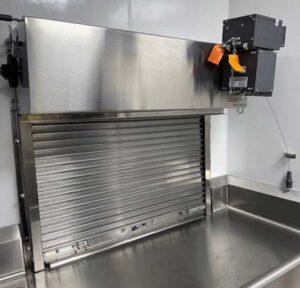 Fire-rated shutters are engineered and tested to prevent the spread of fire and smoke through counter openings in fire-rated walls. These are not optional for uses where they are required by local building codes. These codes are maintained by the Authority Having Jurisdiction (AHD), such as the local municipality or fire marshal. Fire shutters must be UL listed, with a specific hourly rating. Ratings are usually 1.5 or 3 hour and indicate how long the door will stand up to the threat of fire. Fire-rated counter doors have additional design considerations including fire-resistant insulation, thicker gage steel slats, and fusible links that will close the door when broken. Typical applications include hospitals, schools, or commercial buildings where different occupancy types meet. They also require routing testing to make sure the trigger mechanism is functioning as it should.
Counter shutters can be operated manually, by hand crank, or by motor. The optimal choice depends on several factors. One key one is how often the shutter will be cycled. For instance, if it just goes up in the morning, and down at night – manual or hand crank will suffice for many applications. If it’s being cycle many times a day, then motor operation is usually the better way to go. Door size and weight are also factors. A large service counter door would likely be too heavy for manual or hand crank operation, and will require a motor operator.
Making the Right Counter Shutter Selection
As you can see, there are lots of factors to consider when specifying the optimal counter door or shutter for a particular installation. Security level, usage frequency, functional and aesthetic requirements as well as budget will all drive the decision. If you’re ever unsure what’s best for a particular need, customer support teams a rolling door manufacturers and installers will be happy to assist you in understanding the options. Ultimately, you’ll want to make sure that counter door performs as expected and gives years of trouble-free service.
Not sure what counter door is right for your needs?
Contact us today, we’re happy to help you configure the right one.