
This article by Alpine Overhead Doors appeares in the Fall 2026 Edition of DASMA’s magazine, Door + Access Systems. Republished with permission. > Click here to view/download as a PDF.
Editor’s note:
The team at Alpine Overhead Doors offers a fresh perspective on how dealers should view (and sell) rolling doors. For anyone interested in learning more about the wide range of aesthetic options available in today’s rolling door market, this is a must-read story.
Extreme weather conditions continue to push institutional and commercial building designs toward stricter standards to withstand intense storms. With this comes a mandate to incorporate storm shelters or saferooms for buildings in areas where high winds from tornados and hurricanes are possible.
Two standards, ICC-500 and FEMA P-361, have been established to help ensure that critical structural openings do not fail when an extreme wind event strikes. In this article, we’ll look closely at these standards and how they apply to rolling steel doors.
ICC-500 defines enforceable building code requirements for structural design, impact testing, and life safety. It’s officially titled the “ICC/NSSA Standard for the Design and Construction of Storm Shelters.” ICC-500 is jointly maintained by two organizations: the International Code Council (ICC), which is the building safety organization responsible for developing model codes, and National Storm Shelter Association (NSSA), which is the trade association and technical authority special-izing in storm shelter quality, impact testing, and life safety.
FEMA P-361 establishes federal criteria for grant-funded saferoom products. FEMA (Federal Emergency Management Agency) is an agency within the U.S. Department of Homeland Security responsible for coordinating disaster response, reducing risk, and establishing technical safety guidelines.
Securing large egress and wall openings
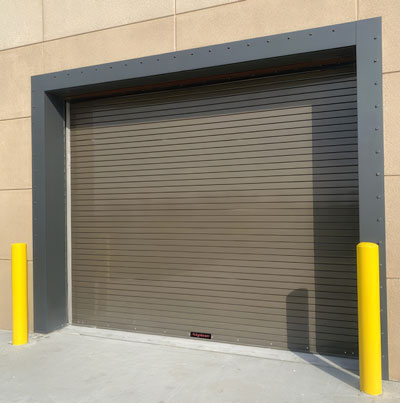
Among the biggest vulnerabilities in any building are its larger exterior and interior egress openings. That is due to their large surface area, lack of adequate internal framing, and the risk of internal pressurization (known as the balloon effect). These openings must have adequate protection against extreme wind pressures and severe missile impacts.
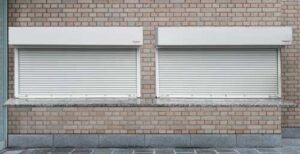
While multiple door types can provide protection, ICC-500- / FEMA P-361-compliant rolling doors are typically used for wide-span openings. Note that these may also be referred to as “Storm Shelter Rolling/Coiling Doors,” “Tornado and Impact-Resistant Rolling/Coiling Doors,” “Severe Wind and Missile Impact Rolling/Coiling Doors,” or similar variations. When the door is used to protect window openings or countertop passthroughs, they may be referred to as ICC-500-Rated / -Certified Overhead Storm Shutters.
ICC performance requirements
ICC sets performance standards that require the following:
- Tornadic debris impact testing — The rolling door system, including the curtain, windlocks, guides, barrel, and locking mechanism, must withstand three direct impacts from a 15-lb. 2×4 wooden stud missile at the most vulnerable points of the assembly. Impact speed is determined by ICC-500 and scales with the project’s design wind speed: up to 100 mph in a 250-mph tornado zone — roughly 5,000 ft.-lbs. of kinetic energy. Hurricane shelters use a lighter 9-lb. missile at 0.5x the design wind speed. The missile cannot pierce or breach the curtain, nor can it cause the hardware to shear or dislodge inside the shelter space.
- Cyclic wind pressure loading — After the impact missile testing, the same door assembly must withstand alternating positive and negative pressure cycles for tornado conditions (1.2x the design pressure). The curtain must remain inside the guides and not suffer structural failure under peak negative suction.
- Continuous load path transfer — The door assembly must also be able to transfer all reaction loads into the host The jambs must be designed in accordance with ACI 318 for concrete and AISC 360 for structural steel.
Design considerations
Tornado and impact-resistant rolling doors have design considerations and structural elements to meet the stated requirements. Keep in mind that ICC-500 is a performance-based standard stating that the door must meet specific performance requirements. So there is some flexibility regarding how a compliant door is designed and manufac-tured for a specific installation. Below are the typical features:
- Heavy-duty interlocking slats — Instead of standard sheet metal or thin-gauge aluminum, shelter-grade rolling door curtains are composed of heavy-gage steel or high-strength aluminum alloys. Curtains are typically composed of flat single-walled or insulated dual-walled interlocking slats. The curtains are designed to flex slightly upon impact, thus dissipating projectile energy without shearing.
- Wind-load system — A critical design function of an ICC-500- / FEMA P-361-compliant rolling door is for the curtain’s ability to stay in place when subjected to missile impact or intense wind Although there are a few different ways to approach this, the common method is to attach windlocks to the ends of the slats. Windlocks are cast-iron or heavy-duty steel components riveted to the slat ends of the curtain. When strong winds or a projectile hit the curtain, the windlocks catch onto an internal windlock bar, preventing the curtain from pulling free from the guides. Windlocks also prevent lateral movement of the slats and limit slat deflection and bending stress.Instead of windlocks, endlocks may also be utilized in conjunction with deeper guide sizes to retain the curtain inside the tracks. Endlocks do not have an internal windlock bar to grab onto, so the larger-sized angles help when slat deflection is high due to intense windload.
- Egress and failsafe operation — If the door is a dedicated egress opening and is motor operated, the operator must have the ability to tie into a building’s alarm Egress operators must also have a manual failsafe override, such as a continuous chain hoist, to allow for post-storm egress should there be loss of power. If it’s a door that remains open during normal operations, then it must be able to close automatically upon receiving a signal from a storm warning system, fire alarm, or loss of main power. It is important to emphasize that not all openings in storm shelters are designated as egress openings.
- Mounting conditions — Under ICC-500, guide track anchorage must strictly comply with either ACI 318 (concrete) or AISC 360 (steel framing). That is required to prevent the track from pulling away from the building under peak negative Note that doors from varying manufacturers may be approved to only specific mounting conditions and/or sizes, so be sure that the door you are sourcing is approved for your conditions and opening size. ICC-500 also mandates special inspections for concrete fasteners to verify proper embedment and load capacity where applicable.
- Fire rating — Some manufacturers offer the option of integrating NFPA 80 fire protection on rolling doors used for openings on fire rated walls without compromising impact Endurance time ranges from 45 minutes to four hours.
- Vision lites — Certain manufacturers have approvals for vision lites, which are see-through window-like inserts integrated directly into the The glazing and its retention system must pass the same three-impact and cyclic pressure testing as the surrounding curtain. They allow for pre-storm clearing, making sure that nobody is outside of the saferoom prior to the storm. After the tornado or hurricane passes, it allows occupants to make sure that safe passage is available by verifying that the exit route is physically clear. Vision lites must only be installed at the factory at the time of original manufacture; installers cannot retrofit, cut into, or add vision lites in the field.
- Other options — There are many other options that may be applied depending on the facility owner or operator’s These include material options such as stainless steel, powder coatings, obstruction sensors, weather seals, hood baffles, and others depending on the specific manufacturer’s offerings.
Not all severe-weather doors are compliant
It’s important to note that there is a critical distinction between ICC-500- / FEMA P-361-compliant rolling doors and high-velocity storm-rated rolling doors, such as those approved by the Miami-Dade or Florida Department of Business and Professional Regulation (FBC).
High-velocity storm rolling doors are designed to withstand static or dynamic wind pressure and light missile impacts for coastal areas.
Conversely, when testing for ICC-500 / FEMA P-361 compliance, the missile impact delivers more than 10 times the kinetic force of standard severe-weather impact tests. Under an ICC-500 impact, a standard high-wind rolling door curtain would fail. Curtain windlocks would shear, or the slats would completely pop out of the side guides, leading to complete failure.
Where are storm shelters required?
Section 423 of The International Building Code (IBC) is the code provision that mandates where and when storm shelters are legally required in commercial and public buildings. Specifically, “The following structures must include a storm shelter constructed in accordance with ICC-500 when located in a 250-mph wind speed zone for tornados per Figure 304.2(1) of ICC-500:
- 911 call stations
- Emergency operations centers
- Fire, rescue, and ambulance stations
- Police stations
- K-12 school buildings with an occupant load of 50 or more, with certain exceptions”
ICC-500- / FEMA P-361-compliant rolling doors may be used in other critical applications not mandated by the guidelines. These include utility plants, water treatment facilities, data centers, high-value secure warehousing, and other applications where operational continuity is required.
Recorded Ef3, Ef4, Ef5 Tornadoes In The Contiguous United States From 1950 Through 2022
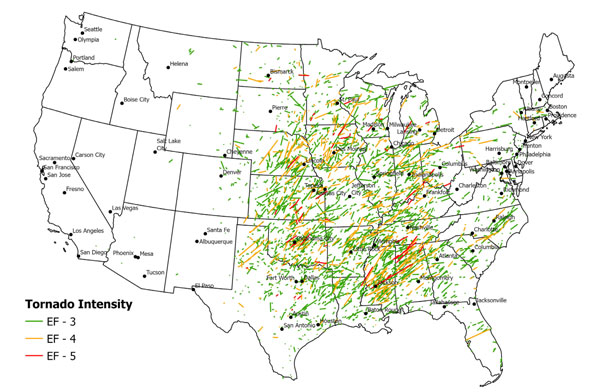
Source: NOAA National Weather Service, Storm Prediction Center
The takeaway
Navigating ICC-500 and FEMA P-361 compliance for rolling doors is more than just another code hurdle; it’s a critical requirement where standard high-wind products simply fall short. For commercial door dealers and installers, understanding these nuances is essential to delivering the right solutions, ensuring pass-rate installation, and avoiding costly
call-backs or failed inspections. When severe weather strikes, a properly engineered and installed shelter-grade rolling door turns a building’s most vulnerable opening into a reliable line of defense.
Philip Paranicas, with the help of the team at Alpine Overhead Doors, wrote this article. Since 1972, Alpine has been manufacturing rolling overhead door systems, including service and insulated doors, fire- and storm-rated, and storefront doors, shutters, grilles, and high-performance coiling doors. To learn more, visit https://www.alpinedoors.com.
Source: “Safe Rooms for Tornadoes and Hurricanes Guidance for Community and Residential Safe Rooms,” FEMA P-361, November 2024 Fifth Edition, Second Issuance.